Showing posts with label Bird. Show all posts

Friday, October 7, 2022

Green Peafowl

 The green peafowl or Indonesian peafowl (Pavo muticus) is a peafowl species native to the tropical forests of Southeast Asia. It has been listed as endangered on the IUCN Red List since 2009 because the global population has been declining rapidly and is severely fragmented due to loss of habitat.[1]It is the national bird of Myanmar.


Unlike the related Indian peafowl, the sexes of green peafowl are quite similar in appearance, especially in the wild. Both sexes have long upper tail coverts which cover the actual tail underneath. In the male, this extends up to 2 m (6.6 ft) and is decorated with eyespots, while in the female, the coverts are green and much shorter, just covering the tail. Outside the breeding season, however, the male's train is moulted and distinguishing the sexes can be difficult unless they are observed up close. The neck and breast feathers of both sexes are iridescent green and resemble scales. In the male, the scapulars, median, and greater wing coverts are blue, while the lesser coverts are green and form a triangle of scaly feathers on the shoulder when the wing is closed. The secondaries are black and in some subspecies, the tertials are brown and/or barred with a faint pattern. The female has blue lesser coverts, so lacks the triangle at the wing shoulder. Females also have neck scales fringed with copper, as well as more barring on the back and the primaries and alula. Both sexes have shafted crests, and are long-legged, heavy-winged, and long-tailed in silhouette. The crest of the female has slightly wider plumes, while those of the male are thinner and taller. The facial skin is double striped with a white to light blue and beside the ear is a yellow to orange crescent. The dark triangle below the eye towards the eyebrow is bluish-green in the male and brown in the female. Seen from a distance, they are generally dark-coloured birds with pale vermillion- or buff-coloured primaries, which are quite visible in their peculiar flight, which has been described as a true flapping flight with little gliding that one associates with galliform birds.

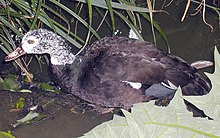
White Winged Duck

 The white-winged duck or white-winged wood duck (Asarcornis scutulata) is a large species of duck, formerly placed in the genus Cairina with the Muscovy duck (Cairina moschata) and allied with the dabbling ducks. However, mtDNA cytochrome b and NADH dehydrogenase subunit 2 sequence analysis indicate that the anatomical similarity to the Muscovy duck is deceiving and that the species is appropriately placed in a monotypic genus, as Asarcornis scutulata, which is evolutionarily closer to the redhead (Aythya americana, one of the diving ducks)


This is one of the largest living species of duck next only to the steamer ducks which are heavier. The Muscovy duck also attains sizes that nearly rival the white-winged duck, but may average a bit smaller in a wild state. Length is 66–81 cm (26–32 in) and wingspan is 116–153 cm (46–60 in). Males weigh 2.94–3.9 kg (6.5–8.6 lb), while females weigh 1.95–3.05 kg (4.3–6.7 lb). The most noticeable feature on adult birds, is the dark body contrasting with a whitish head and neck. Males have mostly dull yellowish bill, blackish mottling on the head and upper neck, white lesser median coverts and inner edges of tertials and bluish-grey secondaries. In flight, white wing-coverts contrast with the rest of the wings. Females are smaller and usually have more densely mottled head and upper neck. The juvenile is duller and browner

Nilgiri Blue Robin

 The Nilgiri blue robin (Sholicola major), also known as Nilgiri shortwing, white-bellied shortwing, Nilgiri sholakili or rufous-bellied shortwing is a species of passerine bird in the family Muscicapidae endemic to the Shola forests of the higher hills of southern India, mainly north of the Palghat Gap. This small bird is found on the forest floor and undergrowth of dense forest patches sheltered in the valleys of montane grassland, a restricted and threatened habitat.


The Nilgiri blue robin (S. major) has the lores black and the upperside, the throat, breast are dark slaty blue but the lower plumage is rufous. The centre of the belly is buffy white. The brow is not as well-marked as in the other species and is diffuse bluish.

white-bellied blue robin

 The white-bellied blue robin (Sholicola albiventris) or white-bellied sholakili, is a bird of the family Muscicapidae. It is endemic to the Shola forests of the higher hills of southern India. The Nilgiri blue robin and this species were once considered separate species, later lumped as sub-species of a single species (major) and elevated again to full species in 2005 by Pamela C. Rasmussen. The species was earlier thought to be related to the shortwings and placed in the genus Brachypteryx and later moved to Myiomela since species in the genus Brachypteryx shows marked sexual dimorphism. In 2017, a study found that this is a sister group of the flycatchers in the genera Niltava, Cyornis and Eumyias among others. It was then placed in newly erected genus Sholicola. This small bird is found on the forest floor and undergrowth of dense forest patches sheltered in the valleys of montane grassland, a restricted and threatened habitat.


This chat-like bird is long-legged and appears chunky with its short tail and wing. Although sharing similar habits and shape, the two species differ in plumage and both may show slight sexual dimorphism. Differences in iris colour between the females have been suggested for S. albiventris

Greater adjutant

 The greater adjutant (Leptoptilos dubius) is a member of the stork family, Ciconiidae. Its genus includes the lesser adjutant of Asia and the marabou stork of Africa. Once found widely across southern Asia and mainland southeast Asia, the greater adjutant is now restricted to a much smaller range with only three breeding populations; two in India, with the largest colony in Assam, a smaller one around Bhagalpur; and another breeding population in Cambodia. They disperse widely after the breeding season. This large stork has a massive wedge-shaped bill, a bare head and a distinctive neck pouch. During the day, it soars in thermals along with vultures with whom it shares the habit of scavenging. They feed mainly on carrion and offal; however, they are opportunistic and will sometimes prey on vertebrates. The English name is derived from their stiff "military" gait when walking on the ground. Large numbers once lived in Asia, but they have declined (possibly due to improved sanitation) to the point of endangerment. The total population in 2008 was estimated at around a thousand individuals. In the 19th century, they were especially common in the city of Calcutta, where they were referred to as the "Calcutta adjutant" and included in the coat of arms for the city. Known locally as hargila (derived from the Assamese words "har" means bone and "gila" means swallower, thus "bone-swallower") and considered to be unclean birds, they were largely left undisturbed but sometimes hunted for the use of their meat in folk medicine. Valued as scavengers, they were once depicted in the logo of the Calcutta Municipal Corporation.


Manipur bush quail

 The Manipur bush quail (Perdicula manipurensis) is a species of quail found in northeastern India and Bangladesh inhabiting damp grassland, particularly stands of tall grass. It was first collected and described by Allan Octavian Hume on an ornithological expedition to Manipur in 1881


P. manipurensis is listed as Endangered on the IUCN's Red List, as its habitat is small, fragmented, and rapidly shrinking.


There was no confirmed sighting of the bird from 1932 until June 2006, when Anwaruddin Choudhury reported spotting the quail in Assam.


BBC News quoted the conservation director of the Wildlife Trust of India, Rahul Kaul, as saying, "This creature has almost literally returned from the dead."

Thursday, October 6, 2022

Lesser Florican

 The lesser florican (Sypheotides indicus), also known as the likh or kharmore, is the smallest in the bustard family[3] and the only member of the genus Sypheotides. It is endemic to the Indian Subcontinent where it is found in tall grasslands and is best known for the leaping breeding displays made by the males during the monsoon season. The male has a contrasting black and white breeding plumage and distinctive elongated head feathers that extend behind the neck. These bustards are found mainly in northwestern and central India during the summer but are found more widely distributed across India in winter. The species is highly endangered and has been extirpated in some parts of its range such as Pakistan. It is threatened both by hunting and habitat degradation. The only similar species is the Bengal florican (Houbarobsis bengalensis) which is larger and lacks the white throat, collar and elongated plumes.


A male in breeding plumage has a black head, neck and lower parts. However, his throat is white. Around three 4 inch long, ribbon-like feathers arise from behind the ear-coverts on each side of the head and extend backwards, curving up and ending in spatulate tip. The back and scapulars are mottled in white with V shaped marks. The wing coverts are white. After the breedings season, the male tends to have some white in the wing. The female is slightly larger than the male. The females and males in non breeding plumage are buff with black streaks with darker markings on the head and neck. The back is mottled and barred in black. The neck and upper breast are buff with the streaks decreasing towards the belly. The outer primaries of the males are thin and notched on the inner-web. The leg are pale yellow and the iris is yellow.

Masked Finfoot

 The masked finfoot or Asian finfoot (Heliopais personatus) is a highly endangered aquatic bird that was formerly distributed throughout the fresh and brackish wetlands of the eastern Indian subcontinent, Indochina, Malaysia and Indonesia. Like the rest of the family, the African finfoot and the sungrebe, the relationship to other birds is poorly understood.


The masked finfoot is an underwater specialist with a long neck, a striking sharp beak, and lobed feet which are green. Both males and females have a black mask and eyebrow that contrasts with a white eyering and lateral cervical stripe. The rest of the neck is grey, the breast is pale and the back, wings, and tail are a rich brown. The males have an all-black chin while the females have a white chin.

Great Knot

 The great knot (Calidris tenuirostris) is a small wader. It is the largest of the calidrid species. The genus name is from Ancient Greek kalidris or skalidris, a term used by Aristotle for some grey-coloured waterside birds. The specific tenuirostris is from Latin tenuis "slender" and rostrum "bill"


Steppe eagle

 The steppe eagle (Aquila nipalensis) is a large bird of prey. Like all eagles, it belongs to the family Accipitridae. The steppe eagle's well-feathered legs illustrate it to be a member of the subfamily Aquilinae, also known as the "booted eagles". This species was once considered to be closely related to the sedentary tawny eagle (Aquila rapax) and the two forms have previously been treated as conspecific. They were split based on pronounced differences in morphology and anatomy; two molecular studies, each based on a very small number of genes, indicate that the species are distinct but disagree over how closely related they are